......................................................................
Five Years:
Unit 2B1 Boothby Road, Archway, London, N19 4AJ
subscribe to mailing list | facebook | @fiveyearsarchway
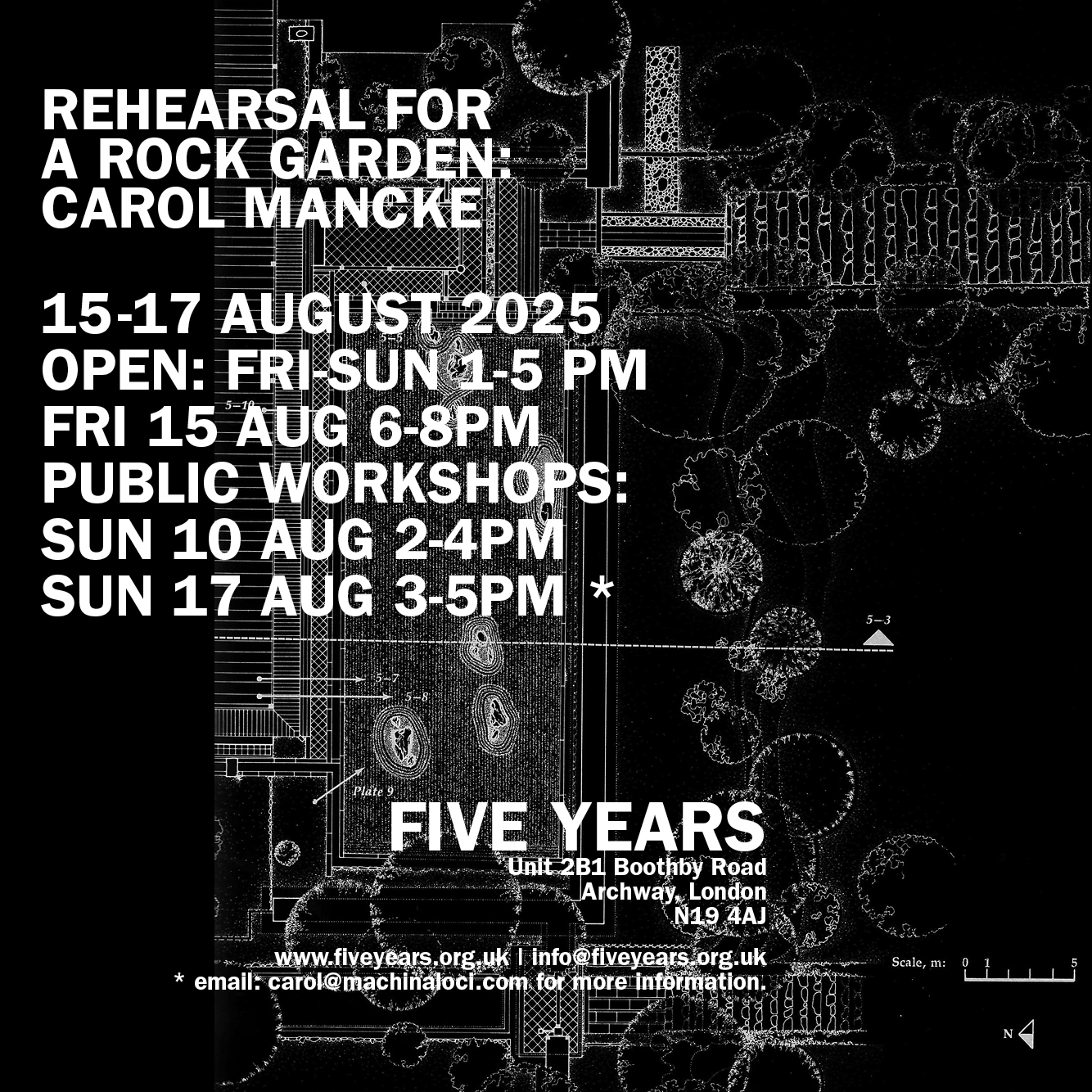
Rehearsal for a Rock Garden:
Carol Mancke
Open to the public: 15-17 August 2025 1-5pm
Friday, 15 August 2025 6-8pm
Sunday 10 August 2-4pm
Natalie Savva and Carol Mancke will host ‘Live Archive’, a participatory performance archiving slides from Natalie’s ‘American Archive’ collection – slide photographs from ranging from the 1940s onwards. Everyone is welcome.
Public workshop:
Sunday, 17 August 15:00-17:00
email carol@machinaloci.com for more information.
Carol Mancke will bring a figment of the 15th century Kyoto Zen Temple garden, Ryoanji, to Five Years this August.
Carol writes:
A strange intersection of interests – rocks, Zen gardens, John Cage’s Ryoanji and Yoko Ono’s Bag Piece has led me to this curious diversion. I once gave a few years of my life to the study of Japanese gardens. Living with a garden maker and his family outside Osaka and enrolled in a nearby university, I spent my weekends in Kyoto soaking up temple gardens. Although not my favourite garden, I was often drawn to Ryoanji – hoping to grasp the compositional complexity that so mysteriously communicates a satisfying simplicity.
Against the celebration of the fleeting, changeable nature of everything in our world that runs through traditional Japanese arts and aesthetics, Ryoanji is a place where you can encounter another kind of time – the radical slowness of rocks. How is this possible? Visited by over a million people every year, as many as two thousand people stream through the temple in one day. Despite this, still and silent, the garden’s rocks offer a portal into another way of being. Life performs its ever-changing dance in view just beyond the garden wall. Every day the rock garden itself is minutely altered when raked and tidied. Nevertheless, the garden’s invitation to savour rock-time, entered my heart.
Back at the university, my colleagues spent long days filling in secret schedules to move green lines on their DOS screens into different mountain-like configurations. A few years later I learned that they were simulating the profiles of the hills and mountains that would remain after the earth and rocks needed to create a new island for Kansai International Airport were taken. Their work was a first step in a process that re-shaped mountains in just a few years.
Looking back, I see that time I spent at Ryoanji and other rock gardens allowed me to glimpse and consider another way of being, even as my colleagues drew their fateful lines. All over the world, lines on screens transform ancient mountains into sinking islands, vibrant forests into mining or agricultural deserts and peaceful villages into war zones. Even after more than forty years, I am confounded by these irreconcilable juxtapositions – man-made gardens performing ‘timelessness’ for us to taste and consider, lines of light drawn on screens destroying life, scraping and scarring the earth, thousands of us passing by. This project emerges haphazardly from my disquiet.