......................................................................
Five Years:
Unit 2B1 Boothby Road, Archway, London, N19 4AJ
subscribe to mailing list | facebook | @fiveyearsarchway
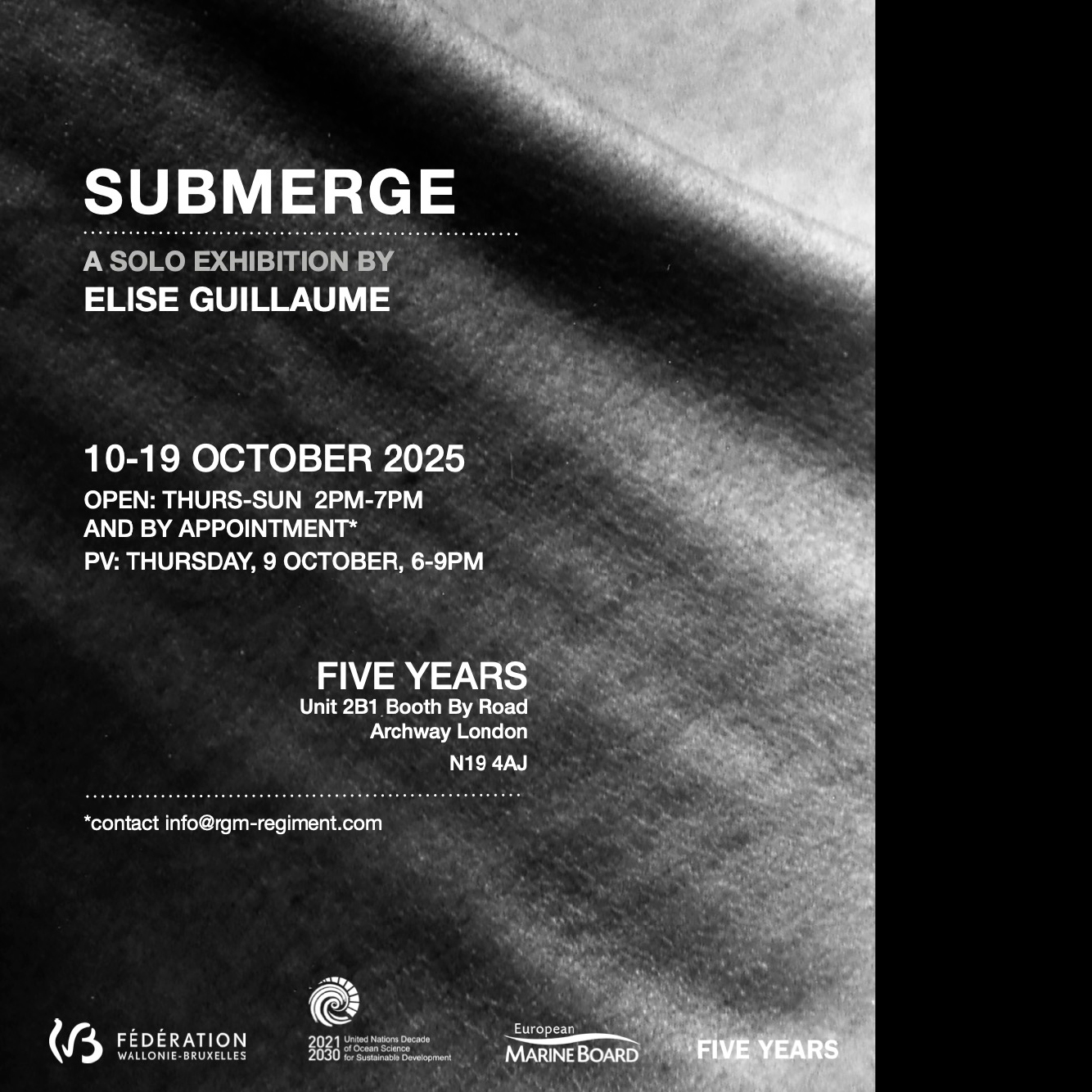
SUBMERGE
A solo exhibition by
Elise Guillaume
Programmed by regiment at Five Years
10–19 Oct | Thurs–Sun, 2–7pm
PV on the 9th October, 6pm - 9pm
or by appointment outside these times please contact: info@rgm-regiment.com
What lies beneath the surface of liquid? Beyond habitual ways of mapping, measuring, understanding, and controlling waterscapes, can we notice what resists containment, what slips between scales of being and imagining?
To submerge – to descend below the surface – is first a physical act. Think of that body of water that once held you: a river, a sea, an ocean that cradled you gently, giving calm, giving joy. Think of when your body entered, dissolved, porous: fluids exchanged. Where did you, human, end, and where did the water begin? Submersion can be pleasure: surrendering in awe, coexisting with something more-than-you, human.
Yet waters that hold can also take. For some, water is fear. For many, submersion is not chosen. As temperatures rise, glaciers collapse, seas advance. Coastal populations are displaced, not by choice but by force. The water engulfs, the sea swallows. Submergence becomes dispossession, violence, grief: an emergency driven by extraction, colonisation, negligence sustained for profit. Higher walls, stronger borders, tighter policies – illusions of control. None can contain what the planet demands. We are called to submerge, but how?
Elise Guillaume’s solo exhibition at Five Years does not attempt to resolve these questions, nor the contradictions they carry. Instead, it lingers within them. Immersion, here, is both intimacy and threat, pleasure and dispossession. Guillaume’s works invite us to submerge otherwise.
To listen, bodily.
Inside the gallery, sound ushers us in: waves crashing, ice fracturing, shells dragged by tides, whales calling, dolphins straining to be heard above the violence of ships, of metallic impacts, of pile-driving. Waves of Resonance, composed from underwater recordings in the North Sea and the Arctic, assembles these voices into a polyphonic field where human and more-than-human collide, overlap, reverberate.
Listening here is neither passive nor merely auditory. It is a demand to quiet down, retune, and learn to register the world differently. To listen with the body (not only with ears) is to become porous – like antennae immersed in a sea of vibrations, resonating beyond the thin skin, attuned to intersubjective currents. We are reminded: we are not separate.
Yet listening also reveals asymmetries. If we hear the ocean, how does the ocean hear us? Marine creatures live with and against anthropogenic infrastructures, forced to adapt to human-made violences. To listen is therefore an act of accountability: attending to what our presence disrupts, a willingness to respond, to alter, to be changed.
This is not merely speculative. Developed in collaboration with environmental psychologist Marine Severin and acoustic ecologist Clea Parcerisas, the piece draws from research workshops across the UK, Belgium, and France, where participants experienced marine sound as affective, embodied sensation rather than abstract data. Emerging from a broader initiative connecting art and ocean science, the work carries traces of those exchanges – the memory of collective listening. Waves of Resonance does not offer sound as aesthetic background, but as relation: inhabiting a world that listens back, that demands response, that refuses detachment.
To transform, viscerally.
Before us stands Regenerate (12.09.2025), a sculptural piece of steel and seaweed that seems to open into the womb of the ocean. An aura of the sacred hovers over it, recalling a portal that invites, beckons, unsettles. Its glow attracts, yet disquiets: beauty entwined with unease, an encounter with the unknown.
The work is composed of Fucus vesiculosus - bladderwrack, an intertidal brown algae from the North Sea, recognisable by the small air bladders swelling along thick, rough fronds. Elise forages both living and dead specimens, then boils, melts, solidifies, and hand-sews them together. These gestures enact a submersion into the species’ metabolic cycles: an immersion not symbolic but material, attuned to the life, death, and regeneration of bladderwrack. What has been extracted or abandoned cannot return; loss is intrinsic, matter reconfigured into new constellations of relation. The work refuses fantasies of an untouched past, staging transformation as precarious, incomplete, contingent: a negotiation of coexistence across species and temporalities. Submersion here acknowledges that life persists not through permanence but through ongoing dissolution and re-formation.
First shown at La Chapelle Jeanne d’Arc, Contemporary Art Centre in France, Regenerate (12.09.2025) belongs to a wider sculptural series of portals, tombs, and windows evolving over time. Across this body of work, repetition is not redundancy but method. The act of boiling, melting, reassembling each piece produces situated knowledge: human and seaweed co-constitute form through constraint, resistance, and collaboration. Labour is exposed not as a mastery but as a gesture of care, exhaustion; the recognition of the human limits of control.
To surrender.
Part of the series Bodies of Water, a black-and-white photograph shows a body stretching, curling, dissolving. Skin flows like waves, like sand shifting on the oceanbed. Boundaries blur. There is no beginning, no end – only movement. Submersion becomes surrender: a letting-go of human singularity, an opening to more-than-human forces. The body destabilises, loses autonomy, becomes porous, entangled, responsive.
This ethic is embedded not only in representation but in process. Bodies of Water is developed using seaweed instead of chemical agents. The material resists, redirects, and intervenes; the image is not captured but co-produced, entangled with algal life, carrying its own agency and temporality. The work enacts what Astrida Neimanis calls hydro-logics: ways of knowing-with water that disrupt linear authorship and insist on reciprocity.
To submerge, here, is to let waters, bodies, and ice move through us – to unmake as much as to make, to dwell in interconnection as a condition for new forms of being-with.
Reflections by Chiara Famengo
This exhibition was made possible with the support of the Wallonia-Brussels Federation, and features works by Elise Guillaume developed during the European Marine Board’s EMBracing the Ocean residency programme, as part of the United Nations Decade of Ocean Science for Sustainable Development.